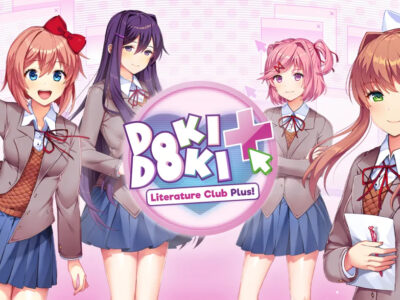
Just a regular dating sim!
Note: not just a regular dating sim. Also a game that’s really hard to review without spoiling the basic premise, so be aware of that before going in.
Continue readingJust a regular dating sim!
Note: not just a regular dating sim. Also a game that’s really hard to review without spoiling the basic premise, so be aware of that before going in.
Continue reading
Who would’ve thought a game where the villain steals people’s faces could be so cute?
Continue reading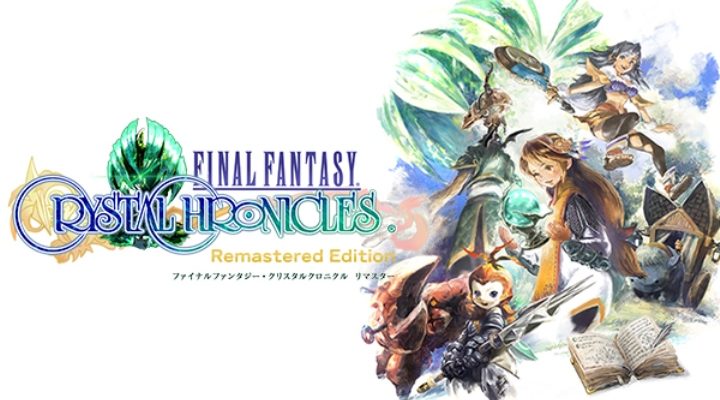
So, the remaster of e Final Fantasy: Crystal Chronicles came out about a week ago, and I have some thoughts.

Not really going to delve too much into the themes here, but there are some things that might be spoiler. However, if you’re reading this post, it’s likely you’ve read the others, which spoil the whole game anyway.)
Today, I’m going to wrap up my look at Silent Hill 2 by giving the same some critiques, and talking about the different versions of the game that are currently available. Including that one.
So, join me, won’t you?
(Content Warning: once again, this game deals heavily with themes of abuse, suicide, illness, and death. Reader discretion is advised.)
Welcome back! I said in the last post on this topic that I was going to talk about the monsters of Silent Hill 2. Well, my friends, that day is today!
So, let’s get started.
(Content warning: This game deals very, very heavily with physical, emotional, and sexual abuse, as well as suicide and mental/physical illness. If these are things you may find triggering, I would probably recommend sitting this one out.
And, as I should probably mention, there will be spoilers ahead as well, though probably not so much if you’ve read the previous post where I basically summarized the whole plot.)
So, if you’ll recall, several months ago I posted a synopsis of Silent Hill 2 as a prelude to a larger discussion about the game’s plot and themes. To that end, today I’m going to be talking about the version of the “otherworld” that exists in this game, as well as the characters.
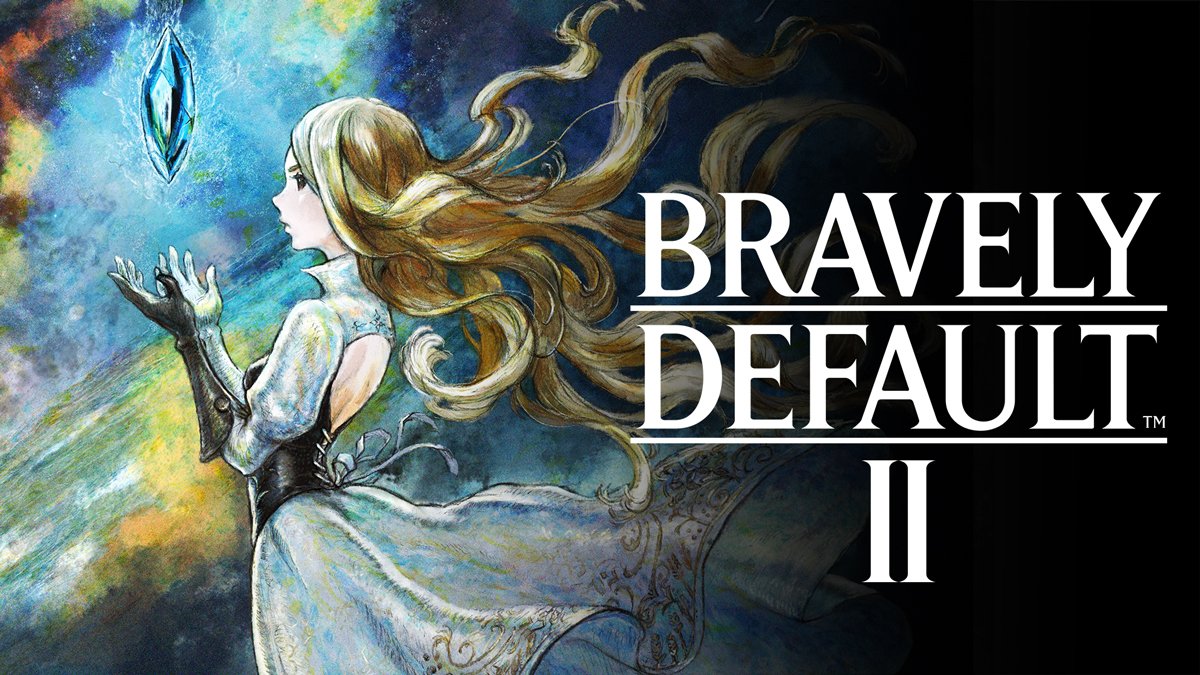
So, was anyone going to tell me there was going to be a Bravely Default sequel, or did I have to learn that when a demo dropped on the Switch store?
First, some background: Bravely Default was an RPG, published by Square Enix for the Nintendo 3DS in 2012. It’s basically a Final Fantasy game, but with a different name: it had a plot revolving around crystals, and a lot of the spells and items were the same. It also had a variation on the job system that a lot of Final Fantasy games have. Essentially, you could change characters’ classes to fill different roles.
One major difference, however, is the mechanic that the series takes its name from: in battles, characters can skip turns to build up “brave points” which can then be spent to give a character more than action per turn. Knowing when to default and when to brave was a key component to winning fights.
Needless to say, the first game in the series was very well received, and it was only a matter of time until a sequel came out. Which is, I think, part of why I was taken by surprise here: there was already a sequel, Bravely Second: End Layer, that came out for the 3DS in 2015.
That one was actually a direct sequel to the first one, featuring a number of the same characters in the same world. That one, however, had a bit more of a lukewarm reception than the first one. So, I suppose that’s why they decided to just go ahead and title the next game Bravely Default II.
Bravely Default II is going to revolve around completely different characters, in a brand new world, which is also how the Final Fantasy series generally operates. This time, we have Gloria, the last remaining princess of a ruined kingdom; Seth, a shipwrecked sailor; Elvis, a scholar; and Adelle, a mercernary. They are on a quest to, you guessed it, save the world. Like the other two games, on their journeys they come across mysterious items called Asterisks, which allow them to take on different roles in battle. In particular, the demo showcases 4: vanguard, monk, white mage, and black mage.
Having played the demo recently, it seems to play mostly the same as the previous titles. One major difference, though, has to do with the hardware. Since the 3DS had two screens, the bottom screen was utilitzed to show maps or other information, while character movement, battles, and scenes took place on the top screen. Since the Switch only has one screen, all of the information has to be presented on that screen. There’s also the fact that the game is at a much, much higher resolution, which makes sense considering that the 3DS is a nine-year-old handheld with fairly small screens.
Another major change from the other two is that the demo seems to have done away with random battles, instead having monsters roam around environments, with battle starting when the party encounters one. This is very similar to how the battles work in the Tales series, or later Persona titles.
The demo, as mentioned before, is currently available on the Switch store if you want to check it out. Unfortuantely, as for a release date, we currently don’t have one other than “sometime this year.” This seems to mostly be so that the developers can incorporate feedback.
I do hope that we get a release date soon, though, because I really want to see more of the game.
(So, fun fact: my job is furloughed indefinitely because of the pandemic! Whee! What that means is I have no idea when I’ll be getting my next paycheck. Fortunately, I have Patreon and Ko-Fi, so if you’d like to support the blog, that’s where you’d do it. Thanks!)
Release Date: 3/20/20
Publisher/Developer: Nintendo
Platform: Nintendo Switch
Price: $59.99 USD
So, I don’t know if you folks have noticed, but shit kind of fucking sucks recently. Thankfully, there’s a new game that will help take your mind off that, at least for a little while.
Animal Crossing has been one of Nintendo’s most popular series since the first game came out in 2002 for the Gamecube. The premise of the series is fairly simple: you’re a regular human, moving to a village populated by inexplicably anthropomorphic animals. Throughout the game, you can do things like sell bugs, fish, and fruit to the local vendor in order to make money, which you can then use to purchase or expand your home, buy furniture, clothes, and other items.
This game actually takes that premise a step further: rather than moving into an already established village, you’re moving to a deserted island and have to build one up from scratch. To that end, they added a new feature: a souped-up version of the crafting system from Pocket Camp. Unlike Pocket Camp, however, you actually make the items in question yourself, and there’s no waiting period: the item is available as soon as you craft it.
This is something that makes it quite easy to furnish your home without having to spend a lot of the game’s currency, bells. For example, here’s an image of my house’s interior. Every item in the home was crafted, except for the moss ball and the fish:
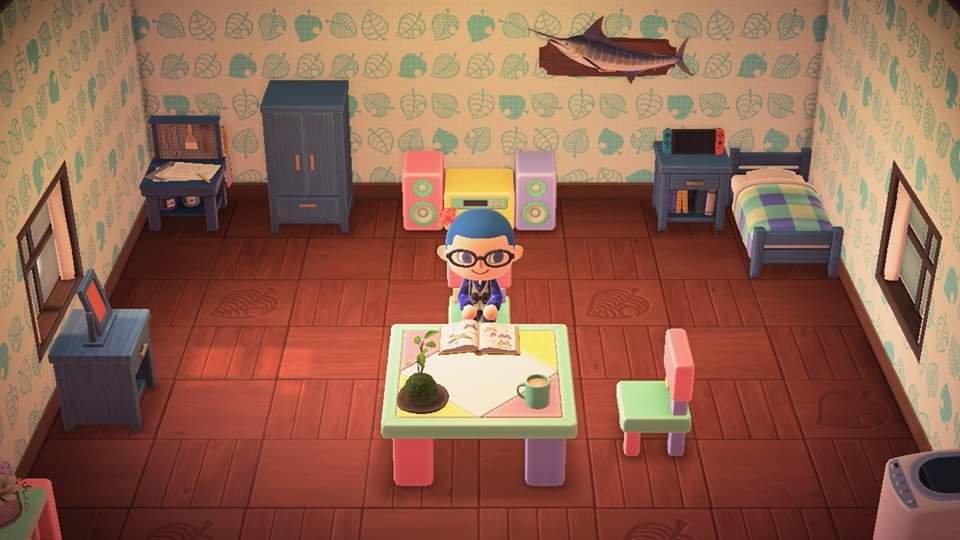
As far as crafting is concerned, you can actually gather materials for that pretty easily. Wood, for example, is gained by hitting trees with axes (naturally), and you can also get branches by shaking them. Rocks, clay, and other minerals are gathered by hitting rocks with a shovel or an axe. It should be noted, though, that the tools in this game do deteriorate over time, but you can craft most of them pretty easily. It also adds a couple of new tools: the vaulting pole, which you can use to cross rivers; and the ladder, which is used to scale small cliffs to explore other areas of the island.
New Horizons, of course, has a multiplayer feature as well. By going to the airport, you can either visit your friends’ islands, or have them come to yours. Also, you can use the game’s secondary currency, Nook Miles, to fly to randomized islands, which is a good way to gather new resources, or even invite new animal villagers to come to your island.
Speaking of Nook Miles, they work similarly to the MEOW coupons from the previous title, New Leaf. They’re basically extra points that you can get by doing things around the island, which you can then exchange for plane tickets, new crafting recipes, or items that expand your inventory.
Visually, the game is quite nice, with a lovely cartoony style that complements it’s general tone. It’s cute, is what I’m saying. It’s very, very cute.
So, would I recommend this game? Yes, of course I would. I think we could all use a little light-heartedness right now.
Though, given current circumstances, I would probably recommend buying it digitally.
(So, fun fact: my job is furloughed indefinitely because of the pandemic! Whee! What that means is I have no idea when I’ll be getting my next paycheck. Fortunately, I have Patreon and Ko-Fi, so if you’d like to support the blog, that’s where you’d do it. Thanks!)
(Content warning: this game deals very, very heavily with themes of emotional, physical, and sexual abuse, as well as suicide, illness, and loss. If these topics are triggering to you, you might want to sit this one out.)
If you recall, a while back I wrote a series of posts about one of my favorite games, Silent Hill. I figured that now is a good time take a crack at that game’s sequel, 2001’s appropriately titled Silent Hill 2.
So, to kick this off, I’m going to go over the game’s plot. I highly recommend playing the game if you’re able, as it is something best experienced first hand. Otherwise, by all means, read on.
 Katethulu's Cave Of Mysteries