Category Archives: Mythology/Folklore

Mythology Monday: Scottish Murder Horses

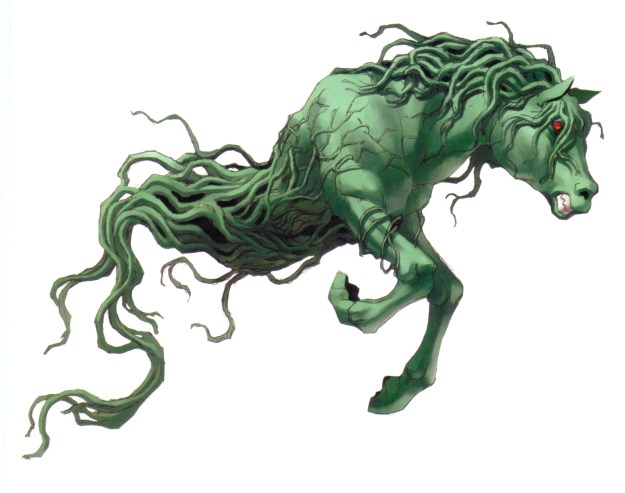
Kelpie

Today, I’ve decided to talk about one of Scotland’s more peculiar mythological beasts: horses that can kill you.

But Katie, I hear you say, can’t regular horses kill you, by kicking you in the head or whatnot? Well, yes, but that’s not really this critter’s MO. So sit back while I tell you about kelpies, also known as water horses.

Continue reading

Mythology Mondy: Zeus Turns Into A Bull To Get His Dick Wet

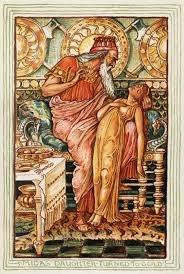
display-image-php_79_orig

So, there are a handful of Greek myths where Zeus turns himself into an animal to get with some lady. This is one of them

So we start out with this Phoenician princess named Europa. Now Europa is super, super gorgeous, and one day she attracts the notice of Zeus while she’s chilling on a beach somwhere. Since Zeus’s main defining feature is a chronic inability to keep it in his pants, he decides that he really needs to bone down with her.

Zeus then comes up with a cunning plan. A cunning plan that involves turning himself into a white bull.

He then goes and hangs out in Europa’s dad’s herd for a while, and then just kinda waits. Eventually, Europa comes by and sees the Zeus-bull, and then thinks it might be a good idea to ride it. Not, you know, sexually, but like you’d ride a horse.

So she jumps on the bull’s back, and the bull carries her off to Crete, where he reveals himself as Zeus. He then sets about seducing her. I use the term seduce very, very loosely here, because Zeus isn’t really known for taking no for an answer. Either way, Europa has three kids by him: Minos, whose wife would go on to fuck her own bull; Rhadamanthys, who becomes a judge in the underworld, and the warrior Sarpedon.

Zeus then leaves her with three gifts: a super-rad javelin, a bronze bodyguard, and a dog. Europa would eventually go on to marry the Cretan king Asterius, who adopted her three demigod kids as his own. So things ended up pretty well for her, which is a nice change of pace from how most of Zeus’s flings go.

Side note, I find Zeus turning into a bull to seduce Minos’s mom pretty funny, considering what Minos’s own wife would eventually do.

Mythology Monday: The Curse Of Macha

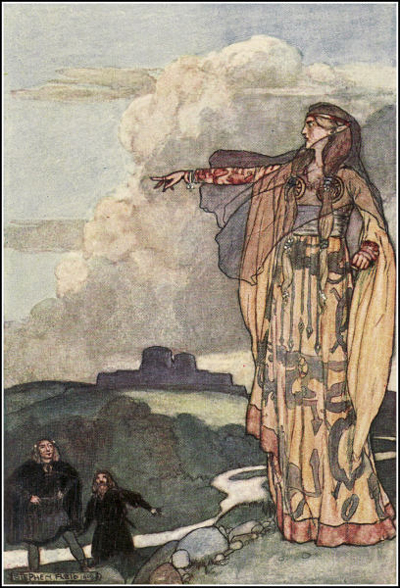
Macha

We’re back in Ireland, though I’m taking a bit of a detour from the Ulster Cycle for a story that really isn’t part of said cycle, but is tangentially related.

So, to start off, we have this farmer from Ulster named Crunden. Crunden’s wife died, leaving him with three small children to raise, a farm to run, and a household to take care of. Now, with the first two taking up most of his attention, the latter kinda falls by the wayside a bit.

The house is a mess, is what I’m saying.

Which makes it really, really surprising when Crunden gets home from the fields one day to find the house miraculously clean, with a random lady cooking supper.

“Hi,” she says. “I’m Macha, and I’m your new wife.”

Crunden, apparently not finding anything about this weird or off-outting, says, “OK,” and the two go on their merry way.

Now, it should be noted that Macha is clearly not human. In fact, she’s from the otherworld, which is where all the gods and the sidhe live. This is indicated by the fact that she runs really, really, ridiculously fast.

Anyway, things are going pretty well, at least up until the king, Connor, gets himself some new chariot horses and decides to throw a huge party for this. Everyone, including Crunden, is invited.

It should also be noted at this point that Macha is super, super pregnant. As in about-to-give-birth-at-any-moment preggers. So she takes her husband aside before the party and warns him not to brag her up, or bad shit will happen. He assures her that he won’t, and heads off to party down.

Crunden manages to keep his promise in the face of all the other dudes their bragging about their wives, but then the king says that his horses are the fastest things alive.

Crunden says, “Oh, yeah? Bet my wife can outrun your horses.”

The king does not take to kindly to this boast, and has a couple of his guards bring Macha by so her husband can put his money where his mouth is. Macha, desperately, tries to get the king to realize that maybe forcing a heavily pregnant woman to run a race is a terrible idea. When this doesn’t work, she tries to appeal to his cadre of warriors, but they want to see where this is going too.

So, with no other choice, the race is on. Surprise, surprise, Macha goes into labor during the race, which she wins. Right on the finish line, she then gives birth to stillborn twins.

Understandably upset by this turn of events, she scoops up her dead babies and lays a curse on the men of Ulster. Basically, from now until the end of time, they’ll experience labor pains at the time they need their strenght the most. She then runs off, never to be seen again.

The fortress is then named Emain Macha, or “Macha’s twins.”

And the moral of the story is Jesus Christ don’t force pregnant women to race horses.
Mythology Monday: Celebrate Christmas With Horse Skulls

(Hat tip to my sisters Sarah and Amanda, who both shared posts about this on Facebook and thus inspired this post)

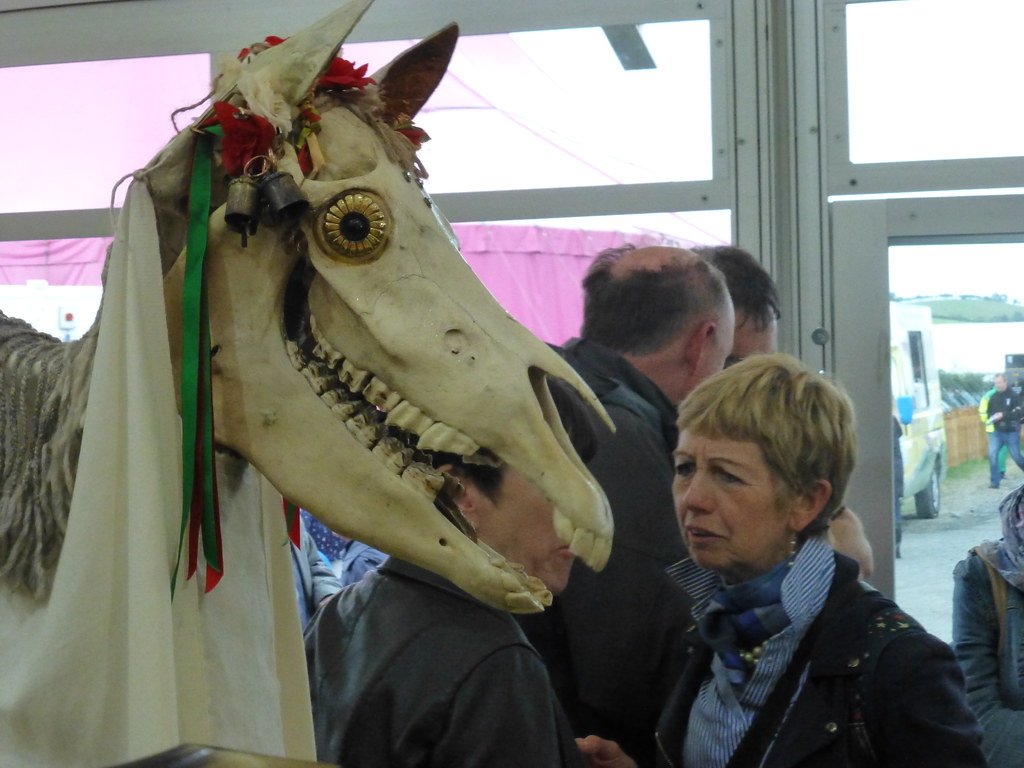
So, this week, I’m going to do something a little bit different: rather than talking about a mythological creature, figure, or story, I’m going to instead talk about a tradition. And, since Christmas is almost upon us, I am going to talk about the Welsh tradition of Mari Lwyd.

Continue reading

Mythology Monday: Krampus

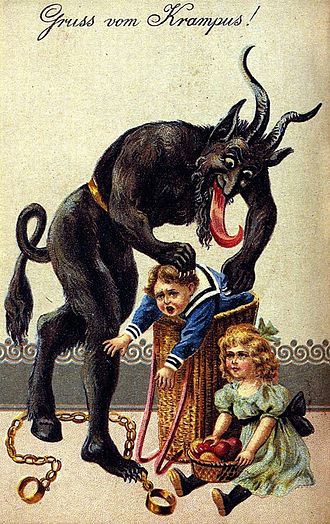
krampus

It’s the holiday season, a time of love, togetherness, and revelry. And, if you’re from certain parts of central Europe, a terrifying goat man.

Yup, today we’re talking about Krampus.

Krampus is a figure that originated around Austria, but is referenced in a lot of places throughout Europe, including Germany, Bavaria, Croatia, the Czech Republic, and northern Italy. He’s a companion of St. Nicholas, and generally visits homes the night before the saint’s feast day of December 6.

And what does Krampus do during those visits, you may ask? Why he punishes children who’ve been naughty, of course! Oh, but there’s none of that “lump of coal” shit here, oh no. No, Krampus whips said naughty children with a birch branch. The really evil kids, though, he stuffs in a giant basket to be drowned or eaten.

Because nothing says “holiday cheer” quite like corporal punishment and kidnapping.

Now, while he is currently associated with  St. Nick, it’s believes that he may be much, much older. One theory is that he’s derived from the Horned God, an ancient European deity currently venerated by Wiccans. Another theory is that he’s actually the son of the Norse cthonic deity, Hel. Either way, it appears that he came to his current role though the magic of syncretism.

Appearance-wise, Krampus is generally depicted as above: a large, hairy black goat-man with a Gene Simmons-esque tongue. Think a satyr, but way, way creepier. Of course, modern depictions of the creature tend to lean way, way heavier into the horror factor.

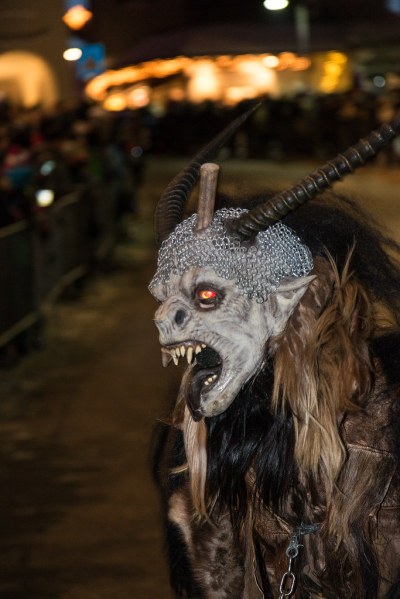
A fesitval called Krampuslauf is quite popular in all the places I mentioned above, but is starting to gain popularity in North America as well. During these events, people dress up as Krampus and parade around. Researching this post lead me to a lot of pictures of these events, and holy shit do people put a lot of effort into these costumes. They are very impressive. Abjectly terrifying, but impressive.

krampuslauf

As things like this tend to do, Krampus has managed to worm his way into popular culture. Most notable is probably a 2015 horror comedy simply entitled Krampus, but the figure has made his way into a lot of different media.

So, there you have it. Proof that the Germanic world will find a way to make the most innocuous things absolutely horrifying.

(Like what I do here? Consider contributing to my Patreon! It helps me pay the bills, and you get some lovely perks as well. I also have a Ko-Fi, with the current goal of eventually upgrading my laptop. Otherwise, as the YouTube community says, like, comment, and subscribe for more stuff like this. Thanks for reading!)