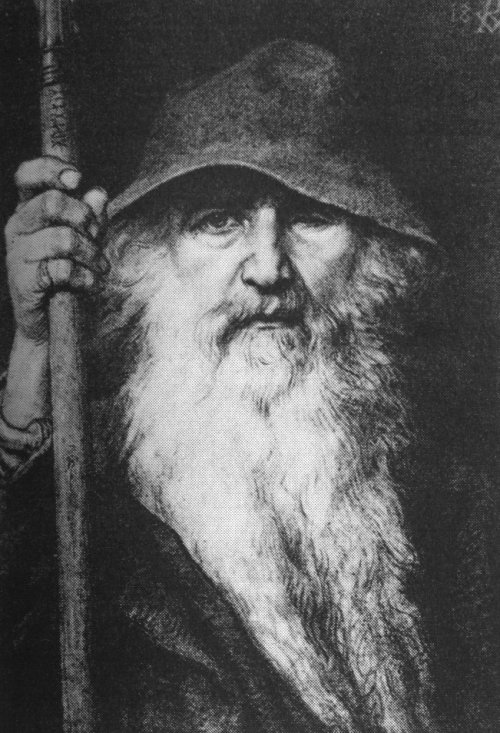
A while back I talked about how Odin sacrificed one of his eyes to drink from Mimir’s Well and gain knowledge. That’s pretty hardcore, right?
Well, my friends, that does not hold a fucking candle to what he does to gain knowledge of runes.
To start off with, what exactly are runes? To answer that, they’re basically the writing system used by the Norse pre-christianization. Think of it as sort of like the alphabet, but pointier. Runes weren’t just a writing system, however: they also held an enormous amount of power.
And, as we all know, Odin is super horny for knowledge, so he decides to break himself off a piece of that.
First, though, we need to talk a bit about Yggdrasil. Yggdrasil, or the world tree, is exactly what it sounds like: a big-ass tree that encompasses the entire world. At the base of Yggdrassil are the three Norns, who determine the fate of every living being on the planet and tend to the Well of Urd, which the tree grows from. They’re basically the Greek Fates, but more Scandinavian. The way that they determine said fates is by carving runes into the tree’s trunk.
So, Odin’s up above, watching all this, and decides to go check it out. Unfortunately, in order to gain rune lore, he has to prove himself worthy, and through pretty drastic means.
Which he does! By hanging himself above Urd’s Well, stabbing himself with a spear, and staying there for nine days with no food or water. Which is, to say the least, a touch extreme.
It works though, and on the ninth night of this he eventually sees the runes in the water below him. This has the added benefit of making him very powerful, even by divine standards, and renders him capable of doing things like healing wounds and disable enemies’ weapons.
One very interesting thing about this tale has to do with rune magic/divination (or seidr), and who was allowed to practice it (at least without getting weird looks). One of the things about Norse society is that it had some pretty strict gender roles. Men usually did the fighting, while women tended to do things like running households. This wasn’t absolute; there were people who went against those roles, though it wasn’t super common.
All this is to say that seidr was typically practiced by women. So, good on Odin for breaking gender stereotypes, I guess.
Like these posts? Please consider supporting this blog on Patreon, Ko-Fi, or PayPal! I currently have a goal where I’m trying to save up enough money to upgrade my computer, so I can do gameplay videos and streams and stuff.
 Katethulu's Cave Of Mysteries