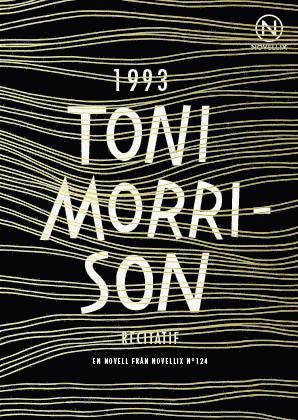
Hello again, people! This week, we’re going to be taking a look at Toni Morrison’s 1983 short story “Recitatif,” which was actually the first story she published.
The story begins with two girls named Twyla and Roberta, with Twyla serving as the story’s narrator. One of the girls is Black and the other is white, but the story never states which is which. The girls are both dropped off at an orphanage called St. Bonaventure’s at 8 years old, despite having mothers. It’s revealed that Roberta’s mother is in and out of institutions for some unspecified mental illness, while Twyla’s mother frequently leaves the girl alone to go dancing.
They end up becoming roommates, and close friends as it becomes clear they don’t fit in with the other children, who are actual orphans. The older girls in particular take a kind of pleasure in tormenting them, as well as a mute kitchen worker named Maggie who the two girls take a keen interest in.
One Easter the girls’ mothers come for a visit and to join them for a church service. Twyla is embarrassed and frustrated by her mother’s inappropriate attire, as well as the fact that she didn’t bring any food so the two have to eat Twyla’s Easter jelly beans. Roberta’s mother is described as an imposing woman wearing a huge cross and holding a bible. She also clearly brushes off Twyla’s mother when the latter moves to shake her hand, much to her and her daughter’s ire.
The day after this, Twyla remembers that Maggie had fallen. This detail, and the girls’ memories surrounding it, becomes very important later on. Eventually, about four months after her arrival, Roberta leaves the orphanage.
About eight years pass, and Twyla is working as a waitress at a Howard Johnson’s when she encounters Roberta again, with a pair of men she doesn’t know. Twyla moves to Roberta and says hello, but Roberta treats her rather coldly. She tells Twyla that they’re one their way to see Jimi Hendrix, and openly mocks her when she doesn’t know who that is. They ask after each other’s mothers before Twyla leaves.
It’s another twelve years before the two meet again. Twyla marries a man named James and the two have a son named Joseph. One day, while grocery shopping, she runs into Roberta. This time, though, Roberta initiates the conversation and the two catch up.
Roberta, it turns out, has moved up in the world, and is married to a wealthy widower and has four stepchildren. They reminisce for a little while about the orphanage, and it turns out that Roberta had returned twice before running away. Twyla then brings up Maggie’s fall, and Roberta says something that makes her doubt her memory of the incident: that Maggie didn’t fall, but was pushed by some of the older girls.
Twyla is kind of disturbed by this revelation, and changes the subject slightly. She asks Roberta why she was so distant to her at the Howard Johnson’s; Roberta blames the whole thing on the racial divide. Roberta does not buy this, but doesn’t say anything about it. Roberta has her driver help Twyla with her groceries, and asks if Twyla’s mother ever stopped dancing. She says that she didn’t, and asks if Roberta’s mother ever got better. The answer to this is also no. After this, they leave, promising that they’ll keep in touch this time.
Some time later, in the fall, Twyla mentions some “racial strife” that came about because of busing. For context, busing was a strategy employed in the 1970s to try and stop de facto segregation in schools. Basically it involved sending kids outside of their school districts. It faced a lot of criticism from both Black and white people.
Anyway, one day Twyla is driving past her son’s school when she encounters an anti-busing protest. And wouldn’t you know it, Roberta is front and center at this protest. She approaches Twyla’s car and the two get into an argument which escalates until the other protestors start shaking Twyla’s car. Roberta doesn’t try to help her, and it continues until a nearby police officer intervenes.
This leads to Roberta saying the following:
“Maybe I am different now, Twyla. But you’re not. You’re the same little state kid who kicked a poor old black lady when she was down on the ground. You kicked a black lady and you have the nerve to call me a bigot.”
This confuses Twyla for a couple of reasons. The first is that she doesn’t remember Maggie being Black. The second is that she doesn’t remember kicking her. The first seems to be more distressing to her than the second, interestingly enough. This causes another argument, until both of them leave angrily.
This encounter prompts Twyla to start counter protesting, with signs that directly answer Roberta’s, but it eventually peters out and both stop coming.
The story’s last encounter happens on Christmas Eve some years later, after Joseph has started college. Twyla goes out to look for a last minute Christmas tree, and decides to stop in a diner while she’s out. It’s here that she meets Roberta, who seems both a little drunk and very distraught.
The two of them sit down to talk, and Roberta reveals that she remembers Maggie being Black, but their last conversation has caused her to doubt her memory. She also admits that they didn’t kick Maggie after she’d fallen, but that she’d wanted to, because Maggie had been institutionalized like her mother was, and Roberta was afraid that would be her fate too. Twyla tells her that they were just kids when it happened.
The conversation then turns back to their mothers, with Roberta’s never getting better and Twyla’s having never stopped dancing. The story ends with Roberta weeping and asking what happened to Maggie.
As I mentioned above, we know that one of the girls is Black and the other is white, but the story remains ambiguous as to which is which. It really could go either way, but what I found more interesting is the clear class difference between the two leads. Twyla works as a waitress and while her family doesn’t seem to be in abject poverty, they’re not exactly well off either. Roberta, in the meantime, marries into money and is shown to be extremely well off. This can even go back to their childhood’s, with Roberta’s mother snubbing Twyla’s. While there may have ben a racial element, Roberta’s mother clearly sees Twyla’s as inferior.
What’s also interesting is how the story seems to center around Maggie, and the girls’ memory of her. Maggie, as a disabled woman, is seen as an outsider much like Twyla and Roberta, and the two girls seem to have projected their own insecurities regarding their mothers onto her, especially Roberta. This is actually stated by her at the end: she knows that Maggie was institutionalized when she was younger, and she worries that would be her fate. That worry became resentment, which was why she wasn’t super worried about Maggie being beaten by the other girls.
So that, my friends, was “Recitatif,” a story about how prejudice can really fuck people up.
 Katethulu's Cave Of Mysteries