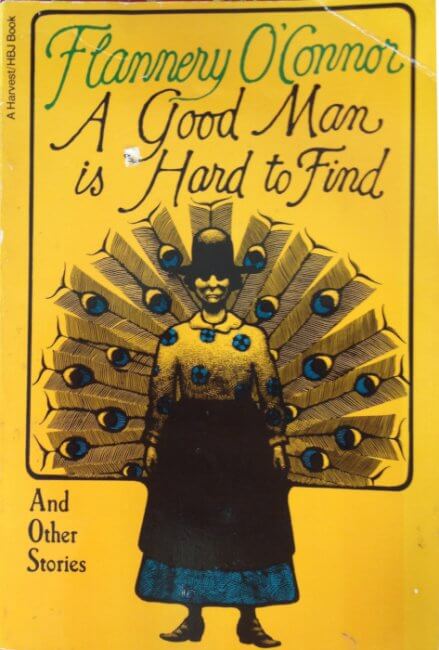
Hello again everybody! This week we’re going to be taking a look at Flannery O’Connor’s 1953 story “A Good Man Is Hard To Find.“
Quick word of warning, though: this story goes to some very, very dark places. Like, child murdery places.
We start of with a family of six: the family patriarch Bailey, his mother, his wife, and their three children: June Star, John Wesley, and a baby simply called “the baby.” The viewpoint character for this tale is the grandmother, who doesn’t get a name beyond that. The family is currently on their way from Atlanta to Florida on vacation.
The grandmother is shown pretty early on to be not a great person, and is actually rather selfish. This leads directly to the tragedy to come, but we’ll get to that later. First, she decides to hide her cat in a basket under the front seat, since clearly he’ll die if she leaves him alone for a couple of days. Second, she tries to convince Bailey to take the family to Tennessee rather than Florida. This is because she doesn’t want to go to Florida, and she has friends in Tennessee.
At first she tries to tell Bailey that the kids have been to Florida before, but have never been to Tennessee. Then she tries to convince him that they shouldn’t go to Florida because there’s a killer called the Misfit on the loose. Bailey will not be swayed, however, and to Florida they head.
While on the way down, the grandmother points out a young Black child to her grandchildren, which she calls a certain word starting with the letter p that I will not say here. June Star notices that the child doesn’t have any britches on, causing the grandmother to comment that he probably doesn’t have any, since Black people “in the country don’t have things like we do.” Except she uses a different slur, this being the one starting with n.
Gross.
Anyway, the family stops at a little gas station with a diner attached for lunch. While there, the grandmother discusses the Misfit with the owner and his wife, as well as how things were better back in her day and that’s all Europe’s fault.
They eat and head out, and a while later the grandmother notes that there’s a house nearby that she wants to visit, and asks her son to make a detour. He doesn’t want to, but the grandmother gets the kids involved by telling them that it has a secret passage where the previous owners hid valuables during the war. This causes the two of them to start badgering their dad to go see it, so he veers off onto a dirt road that the grandmother pointed out to him.
Around this time, the grandmother has a startling revelation: the house she’s thinking of isn’t in Georgia, it’s in Tennessee. This revelation is so startling, in fact, that it causes her to kick her leg out involuntarily. Which startles the cat, which jumps onto Bailey’s shoulder. This causes him to lose control of the vehicle, which flips once before coming to a stop.
Miraculously, nobody is killed, though the mother does get a little banged up. Unfortunately this also means that the group is now stranded, and don’t really have anything to do other than wait in a ditch until someone drives by.
Eventually the grandmother manages to flag down a hearse, and doesn’t think that a hearse on a dirt road in the middle of nowhere isn’t an ominous sign. Anyway, the hearse turns out to hold three men: two of them fairly young, and the third an older ma with glasses. The grandmother thinks that she recognizes the older man, but can’t quite put her finger on it.
I should probably mention that all three men are armed.
The older man has one of the other men, Hiram, go to the car to see if he can get it running. Then he tells the mother to corral her children, who have been crowing excitedly about the accident, because being around kids makes him nervous. She does, and Bailey starts to tell him about what was going on.
This is when the grandmother recognizes the man, and exclaims that he’s the Misfit. This is what seals the family’s fate, as the Misfit ominously tells her that he wishes she hadn’t recognized him. The grandmother tries to appeal to his better nature, but fails, and the Misfit has Hiram and his other companion, Bobby Lee, take Bailey and John Wesley out into the woods.
The grandmother again tries to appeal to the Misfit, asking him if he ever prays. He says that he does not, and the others hear two gunshots. She then asks him why he ended up in jail; he says that they say it’s because he killed his father, but he insists that he’s innocent and that his father died during the Spanish flu epidemic.
Then it’s June Star, the mother, and the baby’s turn to go into the woods. The grandmother again tries to beg for her life, and the conversation turns towards Jesus, and more specifically Jesus’s resurrection of Lazarus. The Misfit is of the opinion that Jesus should not have brought Lazarus back to life, as it sent the world out of whack. He gets angrier and angrier as he talks, before closing out his little speech that there’s “no pleasure but meanness” to be found in life.
As the conversation continues, the grandmother seems to believe that the man is about to cry, and puts a hand on his shoulder, declaring that “you’re one of my own children!” This turns out to be the wrong thing to do, as he responds to this by shooting her three times in the chest.
At this point, Hiram and Bobbly Lee come out of the woods, with Bobby Lee declaring that she was “a talker.” The Mistfit responds, “She would of been a good woman…if it had been somebody there to shoot her every minute of her life.”
Bobby Lee says, “Some fun!” The Misfit tells him to shut up, and “It’s no real pleasure in life.”
So that story got real dark real fast. It’s interesting that it kind of starts out as a kind of banal story about a family trip, before taking a sharp left turn into Murdersville. When the family took the turn onto the dirt road, my thought was that this was how slasher movies start. And I wasn’t entirely wrong in that regard.
One of the main debates about this story is regarding the ending, and the grandmother’s reason for touching the Misfit. The more charitable interpretation is that she had some character growth over the course of the story, and touched him out of genuine empathy. The less charitable one is that she was trying to save her own skin. Both could be somewhat plausible.
What I really want to talk about, though, is nihilism. Nihilism is basically a philosophy that life has no intrinsic value or meaning. This can be considered positively, in that meaning is something we make ourselves, or negatively, in that there’s no real point to anything. The Misfit seems to adhere to the negative one, as he rejects the grandmother’s appeals to religion, and flat out states that there’s no pleasure for him in life.
So the moral here seems to be to stick to the main roads, or don’t be a selfish asshole or you’ll get your whole family killed.
 Katethulu's Cave Of Mysteries