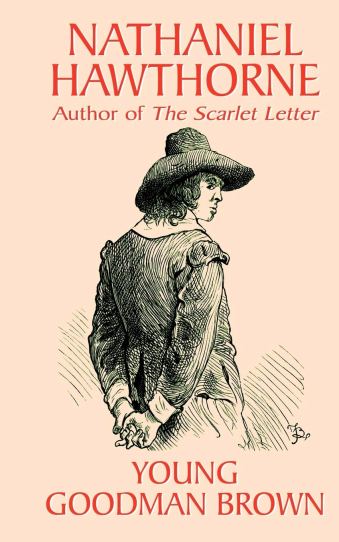
Wow, it’s been a real long time since I’ve read this story.
Nathaniel Hawthorne’s “Young Goodman Brown” was originally published in 1835 and republished in 1846, and has become a staple of high school English classes ever since. It’s a not-too-subtle allegory about the loss of faith, as well as how the Puritans were kind of awful. Which was one of Hawthorne’s favorite subjects, to be fair.
So, let’s get started.
We start with our titular character, Goodman Brown, heading out of his home at sunset against the wishes of his wife, Faith. This is in Salem, by the way, around the time things started getting witch hunty. He tells her that he can’t though, because the journey he’s undertaking has to be done between sunset and sunrise, but he promises her he’ll be back. He then asks her to pray for his safe return.
So he heads down the road on what Hawthorne describes as his “evil purpose,” thinking about how as soon as all this is over he’s never leaving her side again. It’s here that he comes across the person he’s gone out to meet: a man in his 50s with a black staff shaped like a serpent. Also, the older man bears kind of a weird resemblance to Brown.
The man tells him that he’s late, and starts walking with him. He offers Brown his staff, thinking that it would help him move faster. Brown, who is kind of creeped out by it, declines, and the two make their way down the road.
They talk a bit about what they’re doing, and apparently their errand is taking them into a forest. Brown insists that the men of his family are good upstanding Christians, so none of them had ever done what he’s doing now. The older man is like, “Yeah, but I was there and helped your grandfather whip a Quaker woman, and helped your dad set an Indian village on fire.”
Brown’s family doesn’t have a lot of fantastic people in it, is what he’s saying.
Eventually they come across Goody Cloyse, a woman that Brown actually knows pretty well as an upstanding citizen of Salem. In fact, Goody Cloyse used to teach Brown his catechism as a child.
Brown, not wanting to be seen with his current company, tells his companion that he’s going to take a different route. He thinks this is fine, and tells Brown to head into the woods while he sticks to the path.
It’s here that Brown realizes that Goody Cloyse knows the man, and greets him rather warmly. It’s here that I should point out that Young Goodman Brown has been traveling with the Devil. It’s kind of hinted at throughout the story, but this interaction makes it pretty clear.
They have a nice little chat, wherein Goody Cloyse says she has to walk to the meeting because another witch, one Goody Cory, has stolen her broom. The Devil offers her the use of his staff to get there; to that end he throws it down and it comes to life.
Brown catches back up, and is a little freaked out to learn that his old teacher is, you know, a witch. They continue on, but eventually Brown stops, sits on a stump, and refuses to go any further. The Devil’s like, “OK, but I’ll leave you my staff for when you change your mind.”
So Brown’s sitting there, alone, patting himself on the back for not giving into temptation, when he hears horses heading down the road. He hides again, and it turns out he knows their riders: Deacon Gookin and the town ministers. They’re talking about how he wouldn’t miss this meeting for anything. since there’s supposed to be a bunch of witches from all over and they’re going to be welcoming a young woman into their fold.
Remember that part, because it’s important later.
Goodman Brown is really kind of freaking out now, because it seems like almost everyone else in the town are devil worshipers. However, he goes on, and, while he’s walking, he hears Faith’s voice. He cries out to her, and catches one of her ribbons which falls from a tree.
So, turns out the young woman they were initiating was Faith, and this basically breaks Goodman Brown. Laughing like a maniac, he grabs the staff which pulls him to where the ceremony is taking place. Eventually he comes to a large, altar-shaped rock, with a bunch of flaming trees surrounding it. And, of course, the meeting that’s been described throughout the story, populated by people from the village that he’s seen at church every Sunday.
Someone shouts out to bring the converts around, and those converts turn out to be Faith and Goodman Brown himself. Deacon Gookin grabs him by the arms and pulls him forward to stand with his wife at the altar.
A man gives a homily about how evil is the true nature of mankind, and how everyone is a hypocrite. After this, Brown entreats his wife to resist the temptation of the devil, and then all the people, flaming trees, and the altar vanish.
Goodman Brown then stumbles back into town, coming across Goody Cloyse and Deacon Gooking, and avoiding them both like the plague. Faith then sees him near the meeting hall and runs up to kiss him, but he walks past her without a word.
Though he’s never quite sure if what he’d seen was real, Goodman Brown is unable to really trust anyone else ever again, and dies a bitter old bastard.
Now, there’s a very specific reason why this story takes place when and where it does, and that’s Hawthorne’s own connection to the Puritans. His great-great-grandfather, John Hathorne, was actually a judge who presided over the Salem witch trials. This actually brought the family a great deal of shame, which is why Hawthorne has the added W.
Hawthorne wrote a lot about the hypocrisy of the Purtian community; it’s the focus of this story as well as his most famous work, The Scarlet Letter. “Young Goodman Brown” is no different: almost everyone in the story puts on a pious face, but harbors ill intent underneath it.
There is that ambiguity, though, in that everything Goodman Brown saw may not have been real. But, regardless, it does plant a seed of doubt in his mind, and he can’t really go back to what he believed before the incident.
Also, the Puritans just kind of plain sucked. I think that’s something most of us can agree on.
(Like what I do here? Please consider supporting me on Patreon, Ko-Fi, or PayPal! It helps me pay the bills. Patrons also get some perks, so you might want to check those out. Thanks!)
 Katethulu's Cave Of Mysteries